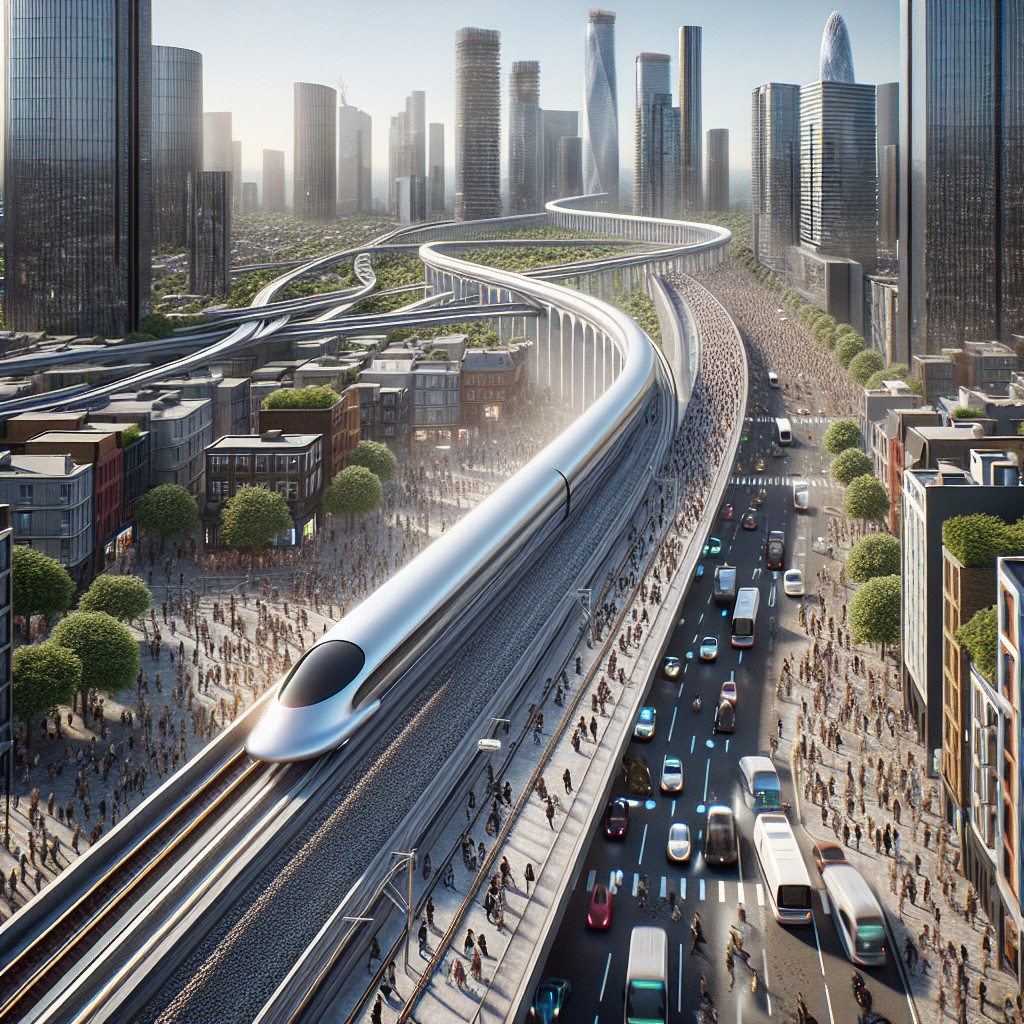
The concept of the hyperloop as a revolutionary mode of transportation has generated significant interest across Europe. Promising ultra-high speeds and reduced travel times, several high-speed project proposals are underway, aiming to reimagine intercity transit on the continent. However, the feasibility and impact of these initiatives require a closer, realistic examination.
Understanding the Hyperloop Concept
The hyperloop technology is centered on pod-like vehicles traveling through low-pressure tubes at speeds exceeding 1,000 kilometers per hour. This setup aims to minimize air resistance and friction, enabling rapid transport between cities. The concept gained traction following proposals by technology innovators and firms aiming to address the limitations of current high-speed rail and air travel.
Current Hyperloop Initiatives in Europe
Europe has become a focal point for hyperloop development. Several feasibility studies and test tracks are under evaluation, spanning countries like the Netherlands, Germany, and France. Notably, projects such as the proposed route connecting Amsterdam to Frankfurt seek to demonstrate how hyperloop infrastructure could unify major economic hubs. The European Union has also shown interest by funding research and encouraging collaboration between public and private sectors to explore this innovative transport solution.
Technical and Regulatory Challenges
Despite enthusiasm, hyperloop projects face substantial technical hurdles. The construction of vacuum-sealed tubes across existing urban and rural landscapes requires massive investments and engineering solutions to ensure safety and reliability. Additionally, regulatory frameworks within the EU present obstacles related to cross-border infrastructure, safety standards, and environmental impact assessments. There is currently no unified regulatory approach explicitly designed for hyperloop technology, which complicates project deployment.
Economic and Environmental Considerations
The financial viability of hyperloop systems remains uncertain. Initial costs for building the infrastructure are expected to be significantly higher than conventional rail, raising questions about return on investment and public funding priorities. From an environmental perspective, proponents argue that hyperloop could offer a greener alternative by reducing reliance on short-haul flights and lowering emissions. However, the actual environmental benefits depend on the energy source for operation and lifecycle impacts, which require thorough analysis.
The Potential Impact on European Mobility
If successfully implemented, hyperloop technology could reshape European mobility by drastically cutting travel times and connecting distant regions efficiently. This could enhance economic integration and competitiveness within the EU. Yet, the timeline for such transformation is uncertain, with practical operation possibly decades away. Interim improvements in high-speed rail and other transport modes continue to play a critical role in Europe’s transportation landscape.
In conclusion, while the hyperloop presents an attractive vision of future travel, current projects in Europe must navigate complex technical, regulatory, and economic challenges. The successful realization of hyperloop networks depends on continued innovation, substantial investment, and coordinated policymaking. For now, hyperloop remains an ambitious prospect with transformative potential, yet its wide-scale adoption in Europe is likely a medium to long-term development.
Frequently Asked Questions about hyperloop
What is hyperloop technology?
Hyperloop technology involves transporting passengers or cargo in pods through low-pressure tubes at very high speeds, aiming to reduce travel time between cities drastically.
Which countries in Europe are currently exploring hyperloop projects?
Various European countries, including the Netherlands, Germany, and France, are involved in researching, testing, or planning hyperloop systems to improve intercity travel.
What are the main challenges facing hyperloop implementation in Europe?
The primary challenges include technical construction difficulties, regulatory hurdles across national borders, high infrastructure costs, and uncertain environmental impacts.
Could hyperloop replace existing high-speed rail systems?
While hyperloop has the potential to complement or eventually surpass high-speed rail in speed, it is unlikely to replace existing systems entirely in the near future due to developmental and financial constraints.
How soon might hyperloop become operational in Europe?
Operational hyperloop systems in Europe are still in the early stages, with realistic deployment timelines extending to several years or even decades, depending on technological progress and regulatory approvals.